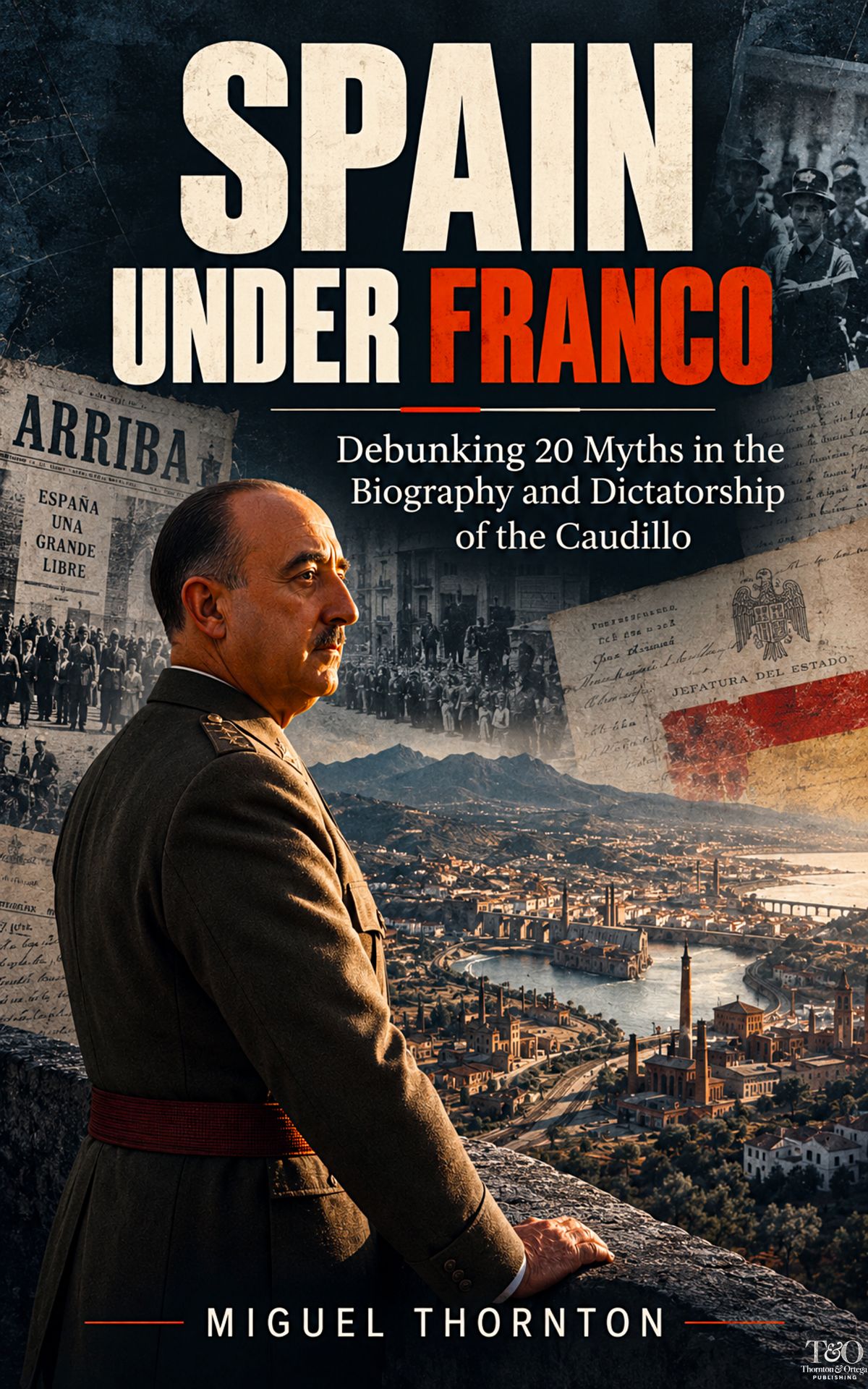
Spain Under Franco
Debunking 20 myths in the biography and dictatorship of the Caudillo
20 chapters · 102 pages · EPUB & PDF
$6.99
EPUB + PDF · instant download
- Secure payment by Stripe
- Instant download
- 14-day refund before download
EPUB + PDF · works on any device · no DRM
Paperback · only on Amazon (opens in a new tab)About this book
Franco is remembered as Hitler’s Spanish understudy, a fascist who crushed a young democracy. The record tells a different story, and this book lays it out myth by myth.
The Spain Franco rose against was already sliding into revolution. Churches were burning, and the leading opposition deputy was murdered by a squad that included state police. Once the war began, thousands of priests, monks and nuns were killed. Franco won that war against a side increasingly dominated by the Communists and armed by Moscow.
He met Hitler at Hendaye and kept Spain out of the Second World War. When the Cold War came, he gave America its air and naval bases in Spain, and Eisenhower embraced him in Madrid. He scrapped the failed state controls of the 1940s and opened Spain to markets and foreign capital. Spain then became one of the fastest-growing economies in the world. He restored the monarchy, trained the king who succeeded him, and left the institutions through which his own parliament voted in democracy.
You come away with the side of the story the textbooks leave out, and the documents to back it up.
Questions about this book
Where do the facts in the book come from?
Each of the twenty chapters ends with a list of sources: scholarly histories, ministers’ memoirs, diplomatic records such as Documents on German Foreign Policy, and studies by Stanley G. Payne and Paul Preston, who disagree on key points.
Does the book also cover the repression, censorship and prison camps?
Yes. Chapter 9 examines the executions during and after the Civil War, the military courts and the concentration camps, setting the competing estimates of several historians side by side. Censorship is treated in chapter 8.
Does the book go beyond the war, covering women, the Church and Jewish refugees?
Yes. Separate chapters cover women’s legal status and the Sección Femenina, the Church and the 1974 Añoveros affair, and Jewish refugees in wartime Europe. Others deal with education, culture and the hunger years.
Reader reviews
No reviews yet.